
Trie 的基本概念
Trie是一种用于存储字符串集合的树形数据结构。它的每个节点表示一个字符,路径从根节点到某个节点表示一个字符串的前缀。
Trie的结构
- 根节点:表示开始节点。
- 内部节点:表示字符串的前缀。
- 叶子节点:表示最后一个字符,通常用于标记字符串的结束。 例子:
         (root)
        /   |   \
       a    b    c
      / \     \  |
     t   n       a
    /            |
   e             t
在上面的例子中,Trie存储了字符串 “ate”, “an”, “bat”, “cat”。
另一个例子:
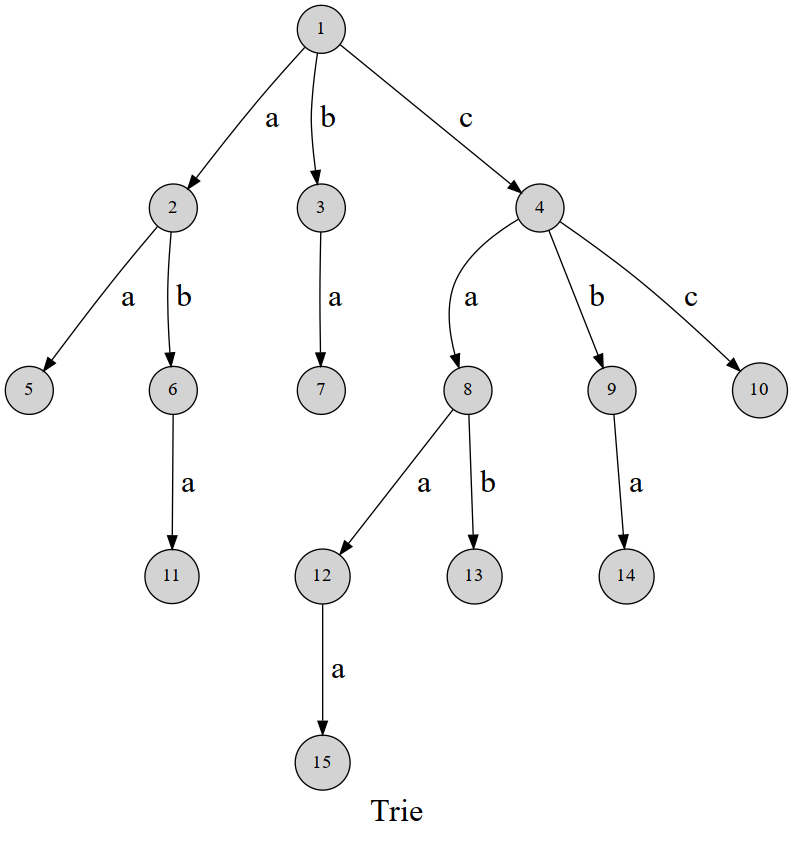 这个字典数用边表示字符,节点表示某种状态。例如, 1 -> 4 -> 8 -> 12 代表
 caa。
实现模板
// 大部分题Trie都是小写字母,26个字母,如果有例外再修改
struct Node {
    Node* son[26]{};// 子树入口
    bool end = false;
    // 其他需要的属性
};

void insert(string word){
    Node* cur = root;
    for(char c: word){
        int idx = c - 'a';
        if(!cur->son[idx]) // 没有子树,说明没有路
        {
            cur->son[idx] = new Node(); // 创建新节点
        }
        cur = cur->son[idx];
    }
    cur->end = true; // 最后一个节点标记为单词结尾
}

bool find(string word){
    Node* cur = root;
    for(char c: word){
        int idx = c - 'a';
        if(!cur->son[idx]) // 没有子树,说明没有路
        {
            return 0;
        }
        cur = cur->son[idx];
    }
    return cur->end; // 最后一个节点是否是单词结尾
}

bool del(string word){
    Node* cur = root;
    for(char c: word){
        int idx = c - 'a';
        if(!cur->son[idx]) // 没有子树,说明没有路
        {
            return 0;
        }
        cur = cur->son[idx];
    }
    if(cur->end) {
        cur->end = false; // 标记为非单词结尾,而非删除节点,避免影响其他单词
        return 1;
    }
    return 0; // 不是单词结尾,无法删除
}
例题:检索字符串
题目描述:给定 n 个名字,接着给定 m 次点名,每次需要回答 “名字不存在”(WRONG)、“名字重复”(REPEAT)或“名字存在”(OK)。
输入格式:
- 第一行包含整数
n,表示n个要插入的名字数量。 - 接下来
n行,每行包含一个字符串,表示要插入的名字。 - 第
n+2行包含整数m,表示m次点名。 - 接下来
m行,每行包含一个字符串,表示要查询的名字。
输出格式:
- 对于每次查询,输出对应的结果:“WRONG”、“REPEAT”或“OK”。
分析:直接使用 Trie 进行插入和查询操作即可。
#include <bits/stdc++.h>
using namespace std;

typedef struct trie
{
    int next[500010][26], cnt; // 50万节点
    bool exist[500010];

    void insert(const char *s, int l)
    {
        int p = 0;
        for (int i = 0; i < l; i++)
        {
            int c = s[i] - 'a';
            if (!next[p][c])
                next[p][c] = ++cnt; // 编号
            p = next[p][c];         // 下一个字符
        }
        exist[p] = 1;
    }

    bool find(const char *s, int l)
    {
        int p = 0;
        for (int i = 0; i < l; i++)
        {
            int c = s[i] - 'a';
            if (!next[p][c])
                return 0;
            p = next[p][c];
        }
        return exist[p];
    }
} T1;

int main()
{
    cin.tie(0)->sync_with_stdio(0);
    int n;
    cin >> n;
    T1 *t = (T1 *)malloc(sizeof(T1));
    t->cnt = 0;
    memset(t->next, 0, sizeof(t->next));
    memset(t->exist, 0, sizeof(t->exist));
    for (int i = 0; i < n; i++)
    {
        string s;
        cin >> s;
        t->insert(s.c_str(), s.length());
    }

    int m;
    cin >> m;
    unordered_set<string> st;
    for (int i = 0; i < m; i++)
    {
        string s;
        cin >> s;
        if (st.find(s) != st.end())
        {
            cout << "REPEAT" << endl;
            continue;
        }
        if (t->find(s.c_str(), s.length()))
        {
            cout << "OK" << endl;
            st.insert(s);
            continue;
        }
        cout << "WRONG" << endl;
    }
    free(t);
    return 0;
}